 ×
Engineered with advanced rare-earth-doped strontium aluminate, zero-power photoluminescent aggregates provide zero-carbon nighttime guidance for municipal parks, commercial pathways, and ecological waterfronts while mitigating urban light pollution.
HANGZHOU, China — For decades, photoluminescent technology has been predominantly associated with indoor life-safety infrastructure: emergency evacuation egress signs, stair nosings, low-location exit route markers, and transit tunnel placards. Today, Hangzhou Junting Luminescence Technology Co., Ltd., a specialized developer and manufacturer of long-afterglow rare-earth luminous compounds, is pushing past traditional use boundaries. By scaling the production of engineered photoluminescent gravel (commercially specified by architects as glow pebbles, luminous stone, or ambient glow aggregates), Junting is successfully extending the crystalline light-storage principles of these materials into exterior municipal hardscapes, park pedestrian footpaths, and commercial landscape architecture.
This strategic expansion reflects an evolving design philosophy: the same solid-state photoluminescent principles that guide occupants out of smoke-filled facilities can passively enhance how public and private outdoor spaces function and visually interact after sunset.

Urban designers, municipal park authorities, civil engineers, and landscape architects worldwide confront an acute planning paradox when engineering nocturnal environments. On one hand, there is a legitimate public demand for legible, secure pedestrian infrastructure after dark. Walkways, botanical trails, canal promenades, garden staircases, and bridge approaches require clear ground-plane visibility to minimize accidental trip-and-fall hazards and provide intuitive pedestrian navigation.
On the other hand, civil project managers face intensifying regulatory pressure to curb municipal power consumption, minimize sub-grade electrical trenching expenses, eliminate recurrent luminaire maintenance cycles, and preserve ecological dark-sky corridors. Conventional electrical bollards and overhead pole-mounted floodlights, while effective for high-speed transit arteries, introduce substantial installation costs. In ecologically sensitive environments—such as protected nature preserves, heritage arboretums, lakefront boardwalks, and tranquil residential courtyards—grid-powered illumination often represents an excessive infrastructure footprint that generates upward light spill, disrupts avian and nocturnal wildlife circadian rhythms, and causes visual glare.
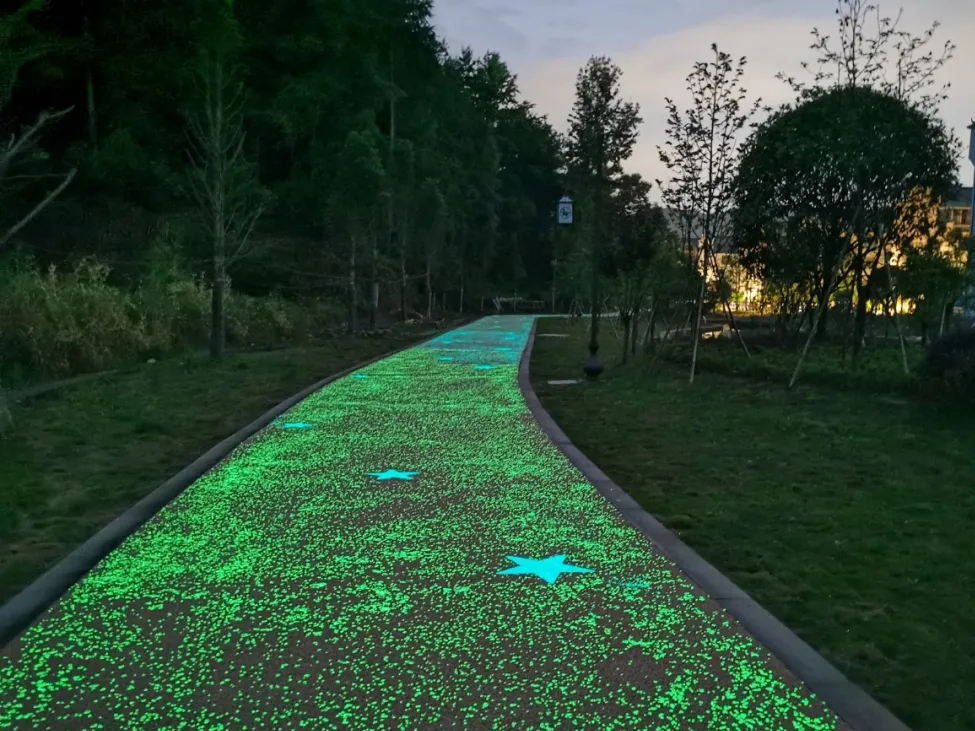
Photoluminescent gravel occupies an entirely distinct engineering classification. By capturing and storing ambient ultraviolet radiation from daytime sunlight or standard ambient light, the aggregate autonomously discharges stored photonic energy as a soothing, continuous glow throughout the night. It functions without copper cabling, distribution panels, transformers, photosensors, or recurring electric utility invoices. Once properly embedded, it operates autonomously night after night for the functional lifespan of the inorganic host matrix.
In line with technical transparency, Hangzhou Junting emphasizes that landscape specifiers must understand the realistic photometric capabilities and decay curves of photoluminescent stone rather than evaluating it against powered light sources:
For specifiers evaluating material options, Junting’s strontium aluminate gravel (SrAl₂O₄:Eu,Dy) and conventional zinc sulfide glow stones (ZnS:Cu) differ substantially across six key dimensions:
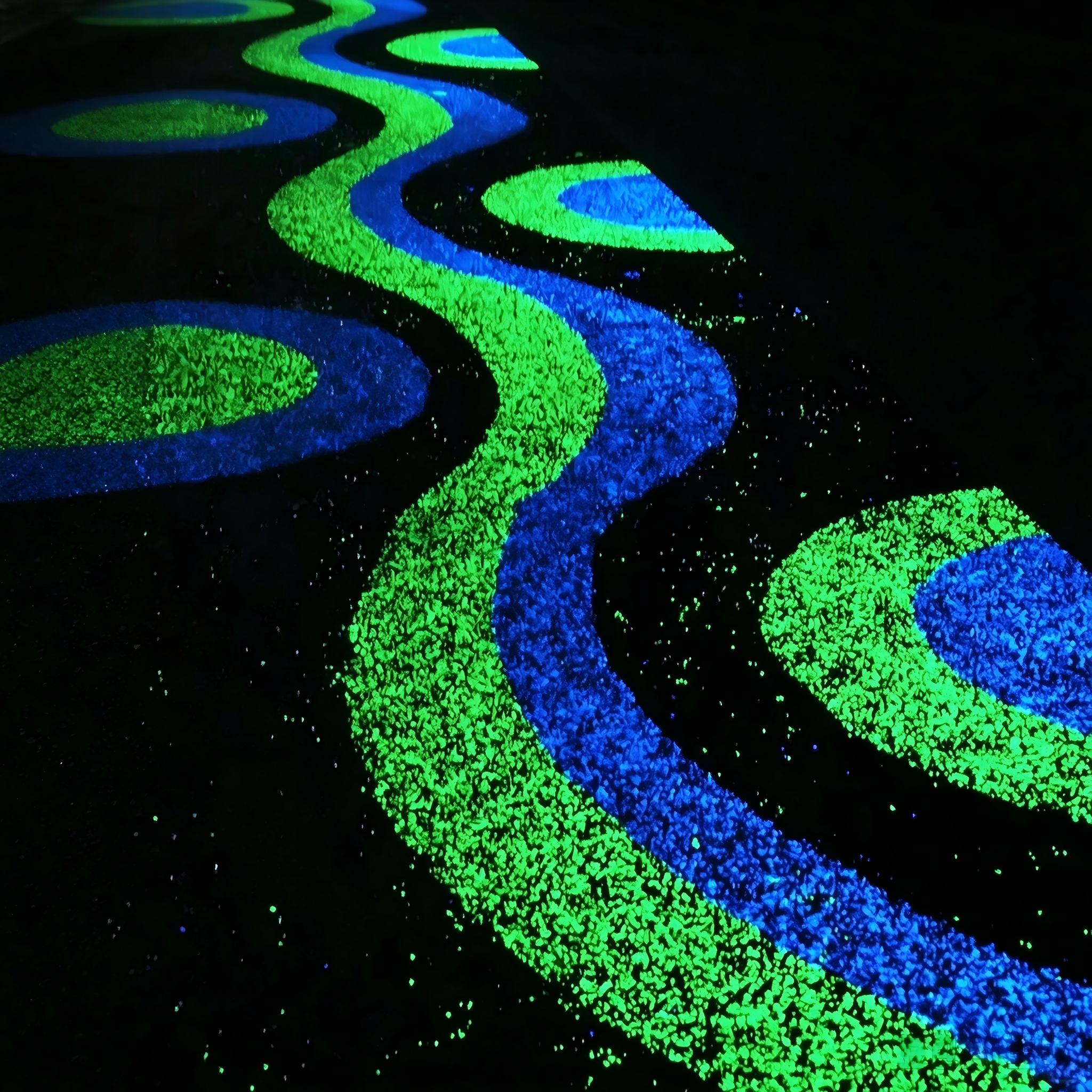
Junting manufactures its architectural glow gravel in three core spectral emission wavelengths, allowing specifiers to calibrate visual ergonomics according to project briefs:
In major municipal park installations, contractors routinely deploy an intentional hybrid pattern: embedding high-output yellow-green pebbles along the primary pedestrian spine for safety wayfinding, while scattering softer sky-blue aggregates through flanking planting beds and rockeries, simulating a wandering celestial walkway that draws evening community engagement.
A primary operational advantage of photoluminescent gravel is its tactile versatility. Unlike rigid safety placards that require mechanical anchors, glow aggregates integrate seamlessly into standardized civil construction systems:
To guarantee project longevity, Junting’s technical specialists consult directly with hardscape contractors regarding aggregate grading (ranging from 1–3 mm micro-chips up to 15–25 mm landscape pebbles), substrate reflectivity, and embedment depth. Embedding the aggregate under an opaque or deeply tinted resin binder will inhibit daylight absorption; conversely, insufficient binder coverage can lead to premature aggregate pull-out under heavy street-sweeping machinery.
“We maintain a disciplined engineering perspective when consulting with architectural specifiers: photoluminescent gravel is not designed to replace high-mast lighting along high-speed interstate expressways or industrial container terminals where standardized lux mandates apply,” said a senior technical director at Hangzhou Junting. “Where it excels is across the expansive ‘long-tail’ of human-scale exterior environments—university campuses, ecological corridors, botanical reserves, luxury hospitality walkways, and civic courtyards. In these spaces, a continuous, zero-energy ribbon of light along the ground provides exactly what modern urban design requires: intuitive safety, visual beauty, and zero carbon emissions.”
As municipalities accelerate their net-zero carbon initiatives and step up dark-sky compliance, the integration of autonomous, daylight-harvesting materials is rapidly transitioning from a novelty into a foundational hardscape standard. Hangzhou Junting Luminescence Technology Co., Ltd. continues to advance material purity, weathering resistance, and custom aggregate processing, ensuring that public walkways around the world can navigate the night safely, beautifully, and sustainably.
Hangzhou Junting Luminescence Technology Co., Ltd. is an ISO-certified manufacturer specializing in rare-earth photoluminescent pigments, inorganic glow aggregates, luminous masterbatches, and safety signage systems. The company supplies architectural, civil engineering, and municipal landscape distributors throughout North America, Europe, Australia, and Southeast Asia. All architectural aggregates are tested to comply with RoHS, REACH, and international non-radioactivity standards.
Architectural Project Inquiries & Sample Requests:
Hangzhou Junting Luminescence Technology Co., Ltd.
Division of Architectural Hardscapes & Landscape Solutions
Technical Correspondence: [email protected]
Hangzhou, Zhejiang Province, People’s Republic of China

Room 815 And 816, Building 2, Dongfang Mao Commercial Center, Hangzhou, Zhejiang
Copyright © 2026 Hangzhou Junting Luminescence Technology Co., Ltd. All rights reserved.
 EN