 ×
×
In the fields of photoluminescent pigments, glow-in-the-dark toys, safety signage, decorative products, and industrial coatings, one issue continues to cause confusion among manufacturers, distributors, and end users alike: unrealistic expectations regarding glow duration.
At Junting, we have spent many years researching, testing, and developing photoluminescent materials for customers across a wide range of industries. Throughout countless projects involving emergency signage, road safety products, architectural materials, consumer goods, and industrial applications, we have observed a recurring pattern. Many users believe that a product's stated glow duration should exactly match what they see in real-world applications. When this does not happen, the product is often assumed to be defective or the technical specifications are considered misleading. In reality, the situation is far more complex.
Drawing upon our extensive experience in product development, laboratory testing, and commercial implementation, we would like to address some of the most common misconceptions surrounding glow duration and explain the factors that truly influence photoluminescent performance.
One of the most widespread misunderstandings in the photoluminescent industry is the assumption that laboratory test data directly represents actual usage conditions. Many long-lasting strontium aluminate glow pigments on the market are advertised with afterglow durations of 8 to 12 hours. These figures are not fabricated. They are typically obtained through standardized testing procedures conducted under controlled laboratory conditions.
During these tests, the pigment is fully charged using a standardized light source and then measured in a completely dark environment using specialized instruments. Under these ideal conditions, the remaining brightness can be detected and recorded for many hours after the charging source is removed. However, real-world environments rarely resemble laboratory conditions.
In practical applications, numerous factors influence perceived glow duration, including:
* Ambient background lighting
* Light pollution from nearby sources
* Surface texture and substrate properties
* Coating thickness variations
* Viewing distance
* Human eye sensitivity
* Pigment loading levels
* Application methods
Even a small amount of surrounding light can significantly affect how visible a photoluminescent product appears to the human eye. As a result, while a laboratory instrument may continue to detect measurable luminosity for 8 to 12 hours, the period during which the glow remains clearly visible to an observer is often considerably shorter.
Based on our project experience, most photoluminescent products installed in typical environments provide a visible glow for approximately 4 to 6 hours under ordinary nighttime conditions. Reaching the maximum laboratory-rated duration of 8 to 12 hours in practical applications is often difficult.
Unfortunately, many customers are unaware of this distinction. When their product remains visible for 4 to 6 hours instead of the advertised 8 to 12 hours, they may conclude that the pigment quality is poor or that the specifications are inaccurate.
At Junting, we believe it is important to understand that laboratory measurements and human visual perception are not the same thing. Technical specifications represent standardized testing results, while real-world performance depends on the specific application environment.
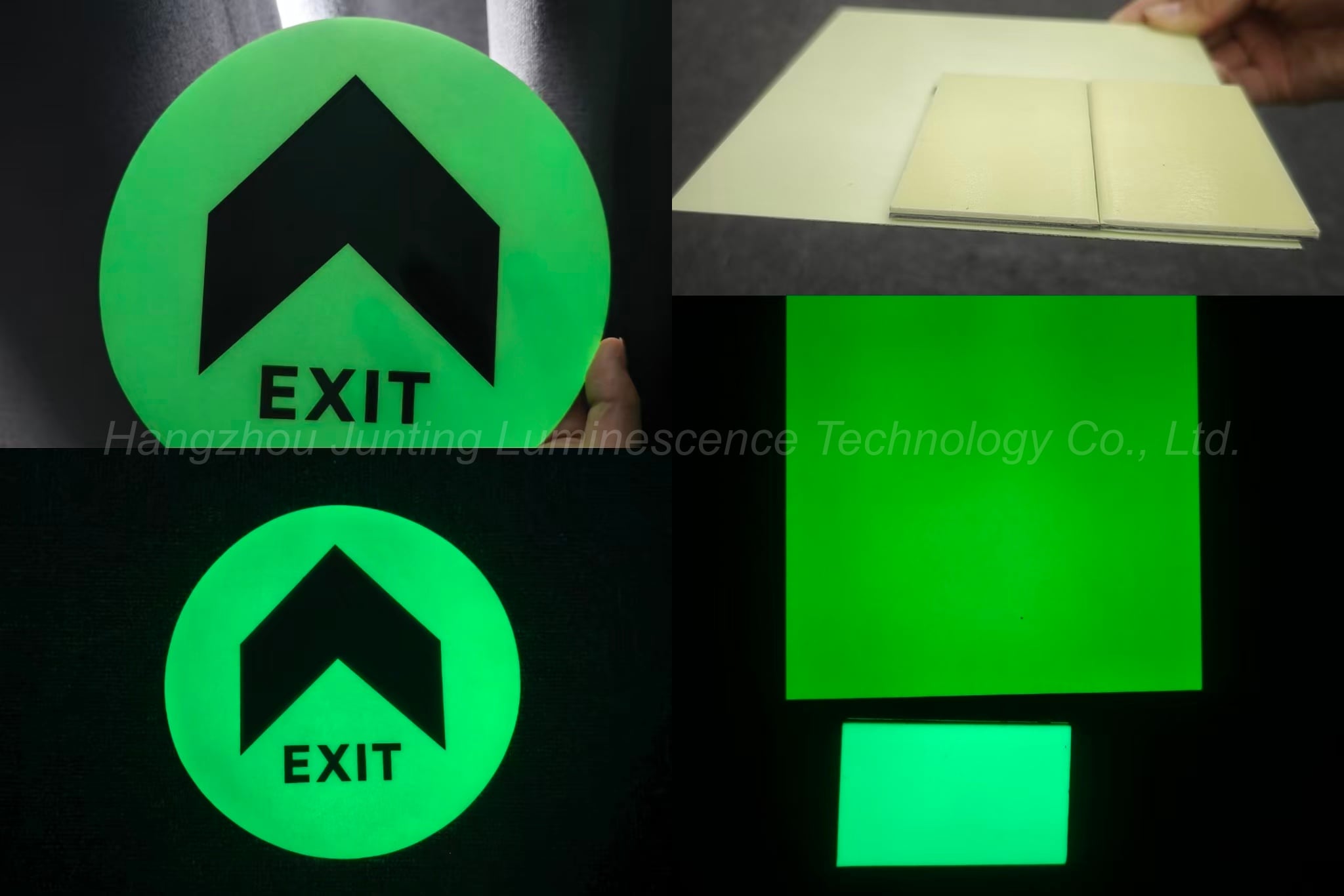
Another common misconception is the belief that the brightest glow immediately after charging will also provide the longest-lasting performance. In reality, initial brightness and long-term glow duration are not always directly correlated.
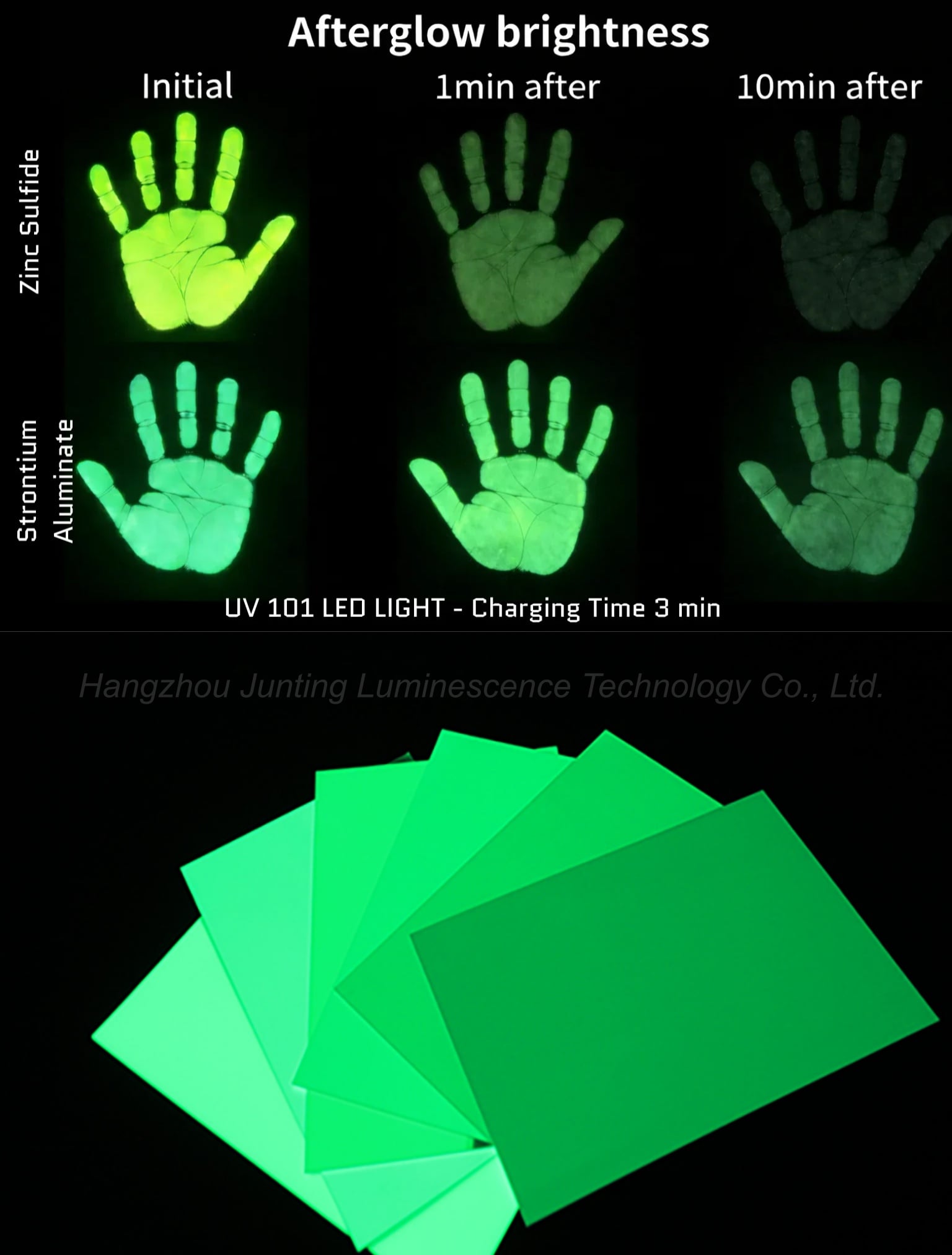
Our research and development team frequently compares different photoluminescent systems to help customers select the most suitable material for their projects. A good example is the difference between traditional zinc sulfide pigments and modern strontium aluminate pigments.
Zinc sulfide glow pigments are known for producing a relatively bright appearance immediately after the light source is removed. This strong initial brightness can create an impressive visual effect during the first few minutes.
However, the brightness declines very rapidly. In many cases, visibility decreases dramatically within one to two hours, making the glow difficult or impossible to see afterward. Strontium aluminate pigments behave differently.
Although their initial brightness may not always appear as intense as certain zinc sulfide formulations, their brightness decays much more gradually. Rather than experiencing a sharp drop-off, they maintain useful luminosity for a significantly longer period.
This slower decay profile allows strontium aluminate pigments to deliver superior long-term performance and a more persistent visual effect, making them the preferred choice for safety signs, emergency guidance systems, pathway markings, and other applications where extended visibility is critical.
When evaluating photoluminescent materials, it is therefore important to consider the entire decay curve rather than focusing solely on the first few minutes after charging.
Beyond the two major misconceptions discussed above, several practical factors can significantly influence actual glow performance.
One of the most common causes of poor glow performance is using too little photoluminescent pigment within a formulation.
Manufacturers sometimes reduce pigment content to lower costs or improve processing characteristics. While this may achieve certain production goals, it often results in weaker brightness and shorter glow duration. Selecting the correct loading ratio is essential for achieving the desired performance.
Photoluminescent pigments rely on carefully engineered crystal structures to store and release light energy. Exposure to excessive temperatures during processing can damage these crystal structures and reduce performance.
This issue can occur during plastic extrusion, injection molding, powder coating, and other high-temperature manufacturing processes. Proper temperature control is therefore critical when incorporating glow pigments into finished products.
The color of the substrate beneath the photoluminescent layer can also affect perceived brightness. Dark-colored backgrounds absorb more light and reduce the visual contrast of the glowing material. In contrast, white or reflective substrates help maximize brightness by reflecting emitted light back toward the observer.
For this reason, we often recommend using white base coats or light-colored substrates whenever maximum glow performance is required.
Coating thickness directly influences the amount of photoluminescent material available to absorb and release energy. Thin or inconsistent coating layers can create weak spots and reduce overall performance.
Proper application techniques and thickness control are essential for achieving uniform glow characteristics.
At Junting, our recommendation is always the same: evaluate photoluminescent materials under actual application conditions whenever possible. Laboratory data provides an important reference point, but no specification sheet can fully replicate the unique conditions of every project.
Whether the application involves safety signage, architectural decorations, industrial markings, consumer products, road safety systems, or glow-in-the-dark crafts, real-world sample testing remains the most reliable method for verifying performance.

Room 815 And 816, Building 2, Dongfang Mao Commercial Center, Hangzhou, Zhejiang
Copyright © 2026 Hangzhou Junting Luminescence Technology Co., Ltd. All rights reserved.
 EN
EN