 ×
×

With more than two decades of dedicated experience in the research and development of energy-storing self-luminous materials, as well as deep engagement in both domestic and international markets, we at Hangzhou Junting continuously analyze industry data, application feedback, and global demand shifts. Based on our long-term observations and accumulated project experience, we have identified four major trends shaping the future development of the photoluminescent industry both in China and worldwide.
These trends are not only influencing material manufacturers like us, but are also reshaping downstream applications across safety systems, infrastructure, consumer products, and emerging creative industries.
The first and most fundamental trend we observe is the acceleration of environmental compliance as a core industry requirement. Driven by global carbon neutrality policies and increasingly strict environmental regulations, the industry is undergoing a clear transition away from traditional sulfide-based photoluminescent materials toward rare-earth strontium aluminate long-afterglow systems.
At Junting, we have long focused on strontium aluminate-based photoluminescent materials, and we are witnessing firsthand how this technology is becoming the mainstream choice in global markets. Compared with traditional sulfide systems, strontium aluminate materials offer significantly improved brightness, longer afterglow duration, and far better environmental stability. At the same time, high-pollution and low-compliance small-scale workshops are gradually being eliminated from the supply chain. This shift is raising industry entry barriers and accelerating consolidation toward compliant, standardized, and technology-driven manufacturers.
From our perspective, environmental compliance is no longer an optional advantage but a fundamental requirement for survival in the industry. We firmly believe that eco-friendly, non-toxic, and radiation-free photoluminescent materials will dominate global demand in the coming years.
The second major trend we identify is the continuous expansion of application fields for photoluminescent materials. While traditional applications such as fire safety signage, emergency evacuation systems, and traffic marking remain stable core demand areas, we are now seeing rapid growth in new and diversified application scenarios.
At Junting we have observed increasing demand from the following emerging sectors:
* Smart city infrastructure
* Nighttime cultural tourism projects
* New energy vehicle interior design
* Smart wearable devices
* Photoluminescent creative products and design materials
In addition, global infrastructure upgrades continue to drive steady demand for self-luminous road markings, emergency guidance systems, and safety signage products. These applications are particularly important in developing regions where nighttime safety infrastructure is being rapidly improved. From our export experience, we have also noticed stable and sustained growth in overseas orders, especially in markets where public safety standards and infrastructure modernization are accelerating.
We believe that photoluminescent materials are no longer limited to functional safety applications. Instead, they are becoming a cross-industry material integrated into design, aesthetics, safety, and smart technology systems.
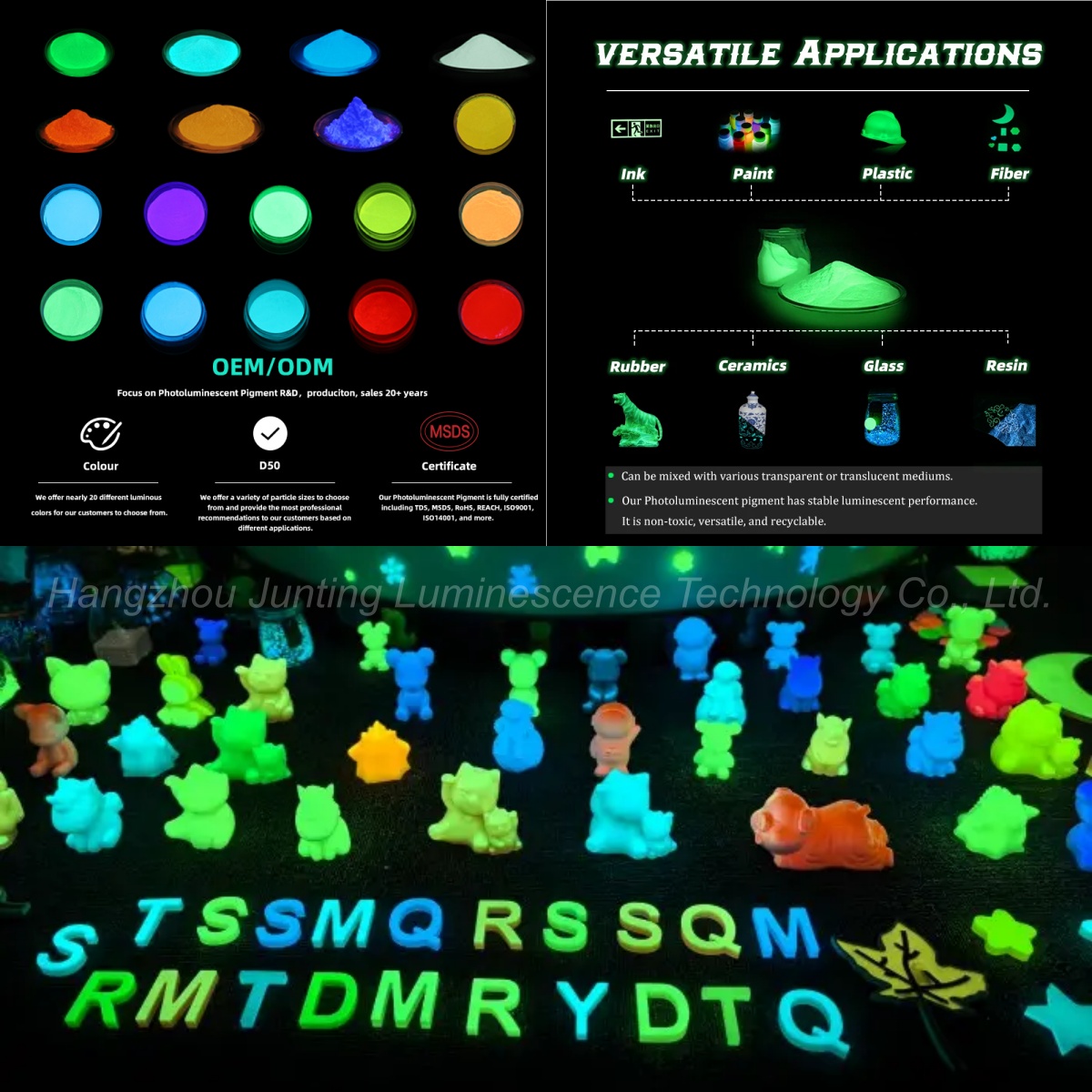
The third major trend is the transformation of product development from standardized mass production toward customized and highly refined solutions. In the past, the market primarily relied on general-purpose photoluminescent powders with limited differentiation. However, this model is gradually being replaced by more specialized, application-driven material systems.
At Junting we have seen growing demand for:
* Ultra-fine particle size materials
* Flexible and printable photoluminescent coatings
* Multi-color temperature customization
* Application-specific performance tuning
This shift reflects a broader evolution in the industry where customers are no longer simply purchasing raw materials, but are instead seeking complete material solutions tailored to specific end-use environments. As a result, leading companies are increasingly moving toward a “material + application solution” service model. This includes not only pigment supply but also formulation support, processing guidance, and performance optimization.
We strongly believe this transition is increasing the technical value of the industry and raising the competitive threshold. Companies with strong R&D capabilities and application engineering experience are gaining a clear advantage in this new landscape.
The fourth major trend is the steady increase in industry concentration driven by stricter compliance requirements and rising technical standards. Regulatory frameworks such as environmental protection laws, ISO quality systems, 3C certification requirements, and EU REACH compliance are significantly increasing the cost of market entry. As a result, smaller and non-compliant production capacities are being gradually phased out. This process is accelerating consolidation within the industry and strengthening the position of established manufacturers with complete production systems and compliance qualifications.
At Junting, we have observed that companies with independent R&D capabilities, large-scale production capacity, and full-chain certification advantages are becoming increasingly dominant in both domestic and international markets. At the same time, Chinese photoluminescent products, including those from industrial clusters such as Yiwu’s light industry sector, are rapidly improving in quality and expanding their presence in high-end export markets. This reflects a broader shift from low-cost competition toward technology-driven value growth.
We believe that as industry standards continue to rise, global market share will increasingly concentrate among a smaller number of technologically advanced and fully compliant manufacturers.

Room 815 And 816, Building 2, Dongfang Mao Commercial Center, Hangzhou, Zhejiang
Copyright © 2026 Hangzhou Junting Luminescence Technology Co., Ltd. All rights reserved.
 EN
EN